
Miniature Pinscher Dog Breed Information
Also known as: Min Pin, Zwergpinscher, Reh Pinscher, King of Toys
A compact German ratting toy with a hackney trot, big personality and zero off-switch. Looks like a small Doberman but is a separate, older breed. Rare in NZ but loved by owners who want a high-drive, low-shedding 4 kg dog.
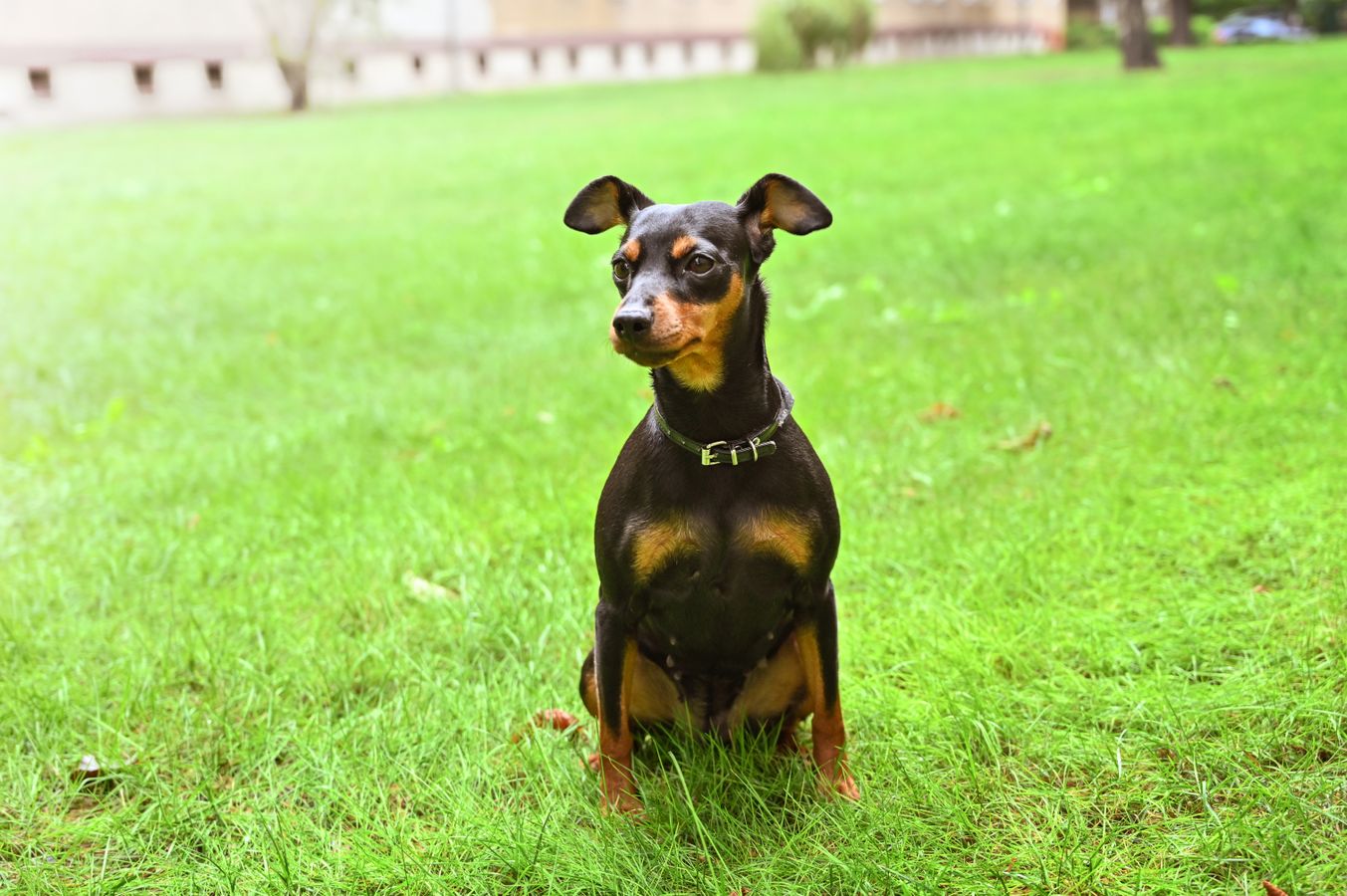
A highly affectionate, high energy, highly playful dog. On the practical side: low grooming demands and minimal drool. The trade-off is vocal.
About the Miniature Pinscher.
The Miniature Pinscher is a 3 to 5 kg German ratting toy with a high-stepping hackney trot, a sharp bark and a personality the breed clubs nicknamed “King of Toys” without irony. The most common assumption new buyers make is that it is a small Doberman, and it is not. The Min Pin is older than the Doberman, shares German Pinscher ancestry, and was a working stable rat-killer in 19th-century Germany before the Doberman existed. The visual similarity is two breeds bred to the same elegant Pinscher type at different sizes.
Adults stand 25 to 32 cm at the shoulder and weigh 3 to 5 kg. The smooth short coat comes in red, stag red (red with black hair tipping), black-and-tan, and chocolate-and-tan. Lifespan is 12 to 16 years.
The signal that defines daily life with a Min Pin is drive. This is not a lap dog in the Cavalier or Toy Poodle sense, even though it weighs the same. The breed has the energy and curiosity of a working terrier in a toy frame, plus a confident, opinionated streak that does not soften with age. Owners who picked the breed for the looks and expected a placid small dog are routinely surprised.
Personality and behaviour
Miniature Pinschers are confident, alert, and busy. They bond strongly to their family but reserve full affection for their inner circle; strangers get a polite but watchful greeting, sometimes preceded by sharp alarm barking. The breed makes a good apartment alarm dog and a poor silent flatmate.
They are not natural cuddlers in the toy-spaniel sense. Most Min Pins are happy to be near you rather than on you, will join you on the sofa for an evening but rarely demand lap time, and prefer to patrol the windows and yard. Some lines are more affectionate; ask the breeder.
The breed has high prey drive. Cats they grew up with are usually fine; visiting cats, rabbits, mice and small wildlife trigger a chase response that is hard to recall out of. The same drive makes them hard off lead in unfenced areas. Plan on long-line work or fenced parks.
They are vocal. Min Pins alert-bark at noises, visitors, other dogs, leaves moving, and most things in between. Reward-based training shapes this down to manageable, but the breed is genuinely barky compared with a Cavalier or a Tibetan Spaniel. Shared-wall apartments and very noise-sensitive households are not a fit.
What surprises new owners is the escape artistry. Min Pins climb, dig and squeeze through gaps that look impossible for the size of dog. NZ owners regularly report dogs scaling 1.5 m fences, opening cat-flaps, or threading through gaps in deck railings. Properly fenced sections matter more than for most toys.
Care and exercise
Plan on around 60 minutes of exercise a day, more for adolescent dogs. Min Pins handle long walks, off-lead play in fenced parks, hikes, and vigorous indoor games. Mental work counts: the breed is happy with food puzzles, hide-and-seek and short scent games at home.
Grooming is the breed’s easy half. The smooth short coat needs a wipe with a damp cloth weekly and a bath every six to eight weeks. Shedding is light year-round, no seasonal blow. Nails grow fast and the breed is rarely worn down enough by walks; trim every three to four weeks or use a Dremel-style grinder.
Dental care is the lifetime job. Min Pins pack a full set of teeth into a small jaw, with the usual toy-breed crowding and disease pattern. Daily brushing from puppyhood, and an annual scale and polish from age three (NZ$500 to NZ$900), keeps the lifetime dental bill manageable.
Cold tolerance is poor. Smooth coat plus low body mass means Min Pins lose heat fast. A fitted coat is standard kit for Wellington winters and essential for Otago and Southland walks below 5 degrees. Indoor heating preferences run higher than for most breeds; many Min Pins seek out heat pumps and sunny patches.
Diet is straightforward but small mistakes compound. Adults do well on 80 to 130 g of quality dry food a day, split into two meals. The breed is athletic enough to stay lean if portions are measured; the trap is treats, which add up fast at toy size. Cap treats at 10 percent of daily calories.
Where to find a Miniature Pinscher in New Zealand
Three honest paths, none of them quick.
- Registered NZKC breeders. The Dogs NZ breeders directory lists registered Miniature Pinscher breeders, but numbers are very low; perhaps a handful of breeders nationwide produce litters in any given year. Expect a 12 to 24 month waitlist and NZ$2,500 to NZ$4,500 per puppy. Ask for patella checks, PRA and MPS VI DNA results, and any Legg-Calve-Perthes history in the line.
- Importing from Australia. A common path for serious NZ buyers given the limited local supply. Budget another NZ$2,000 to NZ$4,000 for transport, quarantine and paperwork on top of the puppy price. Australian Min Pin breeders are well-connected to NZKC; ask the NZKC Toy group for referrals.
- Breed rescue and SPCA NZ. The breed is rare enough that rescue Min Pins are unusual but do appear from time to time. Min Pin crosses (often with Chihuahua) appear more often. Adoption fees NZ$300 to NZ$700.
Avoid Trade Me listings advertising “Miniature Doberman” puppies. The Min Pin is the breed many of those sellers are loosely producing without registration, parent screening, or the breed-specific genetic tests (MPS VI, PRA) that matter. A registered NZKC Min Pin costs the same and brings traceability.
Insurance and lifetime cost
Min Pin insurance claims in NZ tend to cluster around dental disease, patella surgery, and the occasional Legg-Calve-Perthes or hypothyroidism diagnosis. Three things shape lifetime cost.
The first is dental. Most NZ pet insurers exclude routine dental cleaning, and the breed needs annual scale-and-polish from age three. Two or three annual extractions in older dogs can match the original purchase price.
The second is patella surgery. NZ$3,000 to NZ$6,000 per knee. Cheap policies with low per-condition sub-limits run out fast.
The third is the long lifespan. 12 to 16 years stretches every fixed cost. Insurance, food, grooming and registration over a Min Pin life add up to more than for a 10-year breed even on lower per-year costs.
For a typical NZ Min Pin on a mid-range lifetime policy, lifetime cost (purchase plus 12 to 16 years of food, vet, insurance, registration and incidentals) sits around NZ$22,000 to NZ$35,000. Food and grooming costs are low; vet and dental costs sit at the typical small-breed average.
What surprises new owners
Three things come up repeatedly with NZ Min Pin households.
The drive is bigger than the dog. Buyers who picked a small breed expecting a low-input lap dog are routinely caught out by how much physical and mental work a Min Pin actually wants. Underexercised Min Pins are barky, destructive and pushy.
The bark level is real. The breed alert-barks at most things and shapes only partially with training. Apartment dwellers should test tolerance by spending time with an adult Min Pin before committing.
They are not a beginner small dog. New owners who chose the breed expecting a Cavalier-easy or Pug-mellow temperament are often unprepared for the independence and the testing through adolescence. This is a great breed for someone who actually wants a busy, opinionated dog at toy size, and a difficult breed for anyone who wanted a small Cavalier alternative. The Cavalier and the Tibetan Spaniel sit in that latter slot more comfortably.
The Miniature Pinscher, by the numbers.
Each trait scored 1 to 5 on the AKC scale. The verdict synthesises the data; the panels below show the strengths, group averages, and the full trait table.
Top strengths
Family Life
avg 3.3Affectionate with Family
Good with Young Children
Good with Other Dogs
Physical
avg 1.3Shedding
Grooming Frequency
Drooling
Social
avg 4.0Openness to Strangers
Playfulness
Watchdog / Protective
Adaptability
Personality
avg 4.3Trainability
Energy Level
Barking Level
Mental Stimulation Needs
Living with a Miniature Pinscher.
A 24-hour breakdown of how this breed's day typically goes, scaled to its energy, mental-stimulation, and grooming needs.
What a Miniature Pinscher costs to own.
An indicative NZ lifetime cost: purchase, setup, then food, vet, insurance, grooming and other annual outgoings. Adjust the inputs to see how your choices change the total.
A Miniature Pinscher costs about
$196per month
$45
$6
$36,878
Adjust the inputs:
Where the monthly cost goes
Food
$52 / mo
$620/yr · breed-appropriate dry & wet food
Insurance
$48 / mo
$572/yr · lifetime cover protects against breed-specific claims
Vet (avg)
$59 / mo
$710/yr · routine checks plus breed-specific risk
Grooming
$0 / mo
$0/yr · brushes, shampoo, professional clips
Other
$38 / mo
$450/yr · toys, treats, dental, boarding
Indicative NZ averages calculated from breed weight, grooming need and screened-condition count. One-off costs (purchase $3,500 + setup $450) are factored into the lifetime total but not the monthly figure.
How does the Miniature Pinscher compare?
This breed
Miniature Pinscher
$36,878
14-year lifetime cost
- Purchase + setup$3,950
- Food (lifetime)$8,680
- Vet (lifetime)$9,940
- Insurance (lifetime)$8,008
- Grooming (lifetime)$0
- Other (lifetime)$6,300
Reference
Average NZ medium dog
$38,920
12-year lifetime cost
- Purchase + setup$2,200
- Food (lifetime)$13,200
- Vet (lifetime)$6,000
- Insurance (lifetime)$11,400
- Grooming (lifetime)$2,400
- Other (lifetime)$3,720
A Miniature Pinscher costs about $2,042 less over a lifetime than the average nz medium dog, mostly lowerfood and highervet.
What to ask the breeder.
Reputable NZKC breeders test for these conditions and share results without being prompted. If a breeder won't share screening results, that is itself an answer.
Common
2 conditionsPatellar luxation
Reputable NZ breeders patella-check parents.
Dental disease
Daily brushing and an annual scale and polish from age three.
Occasional
3 conditionsLegg-Calve-Perthes disease
Hip joint condition seen in toy and small breeds, treated surgically.
Progressive retinal atrophy (PRA)
An occasional condition in the Miniature Pinscher. Worth asking about and DNA testing where available.
Hypothyroidism
An occasional condition in the Miniature Pinscher. Worth asking about and DNA testing where available.
Rare but urgent
1 conditionMucopolysaccharidosis VI (MPS VI)
Inherited storage disease specific to the breed; DNA test is available.
The Miniature Pinscher in NZ.
- Popularity: Rare in NZ. NZKC registrations are low and the breed is mostly known to small-dog enthusiasts and ex-Australia importers. Most NZ Min Pin sightings are at NZKC events rather than dog parks.
- Typical price: NZ$2500–4500 from registered breeders
- Rescue availability: rare
- NZ climate fit: The smooth short coat suits warmer NZ regions well; Auckland and Northland are no problem. The breed loses heat fast in cold; a fitted coat is essential below 10 degrees in Wellington wind, and a warmer coat for Otago and Southland winters. Healthy adults manage NZ summers without trouble; small body mass means a hot car is fatal in minutes.
- Living space: Apartments suit the breed for size and grooming, but the bark level is high. Townhouse and detached house living is easier. Fenced sections only; the breed is a determined escape artist and will go through gaps a larger dog ignores.
Who the Miniature Pinscher is for.
Suits
- Active owners who want a small but high-drive dog
- Households without small children or other small pets
- Owners home most of the day or with a daycare option
Less suited to
- First-time small-dog owners expecting an easy lap dog
- Households with toddlers
- Quiet shared-wall apartments where barking is a problem
- Owners who can't or won't fence a yard well
Common questions.
Is a Miniature Pinscher just a small Doberman?
Are Miniature Pinschers good with children?
Are they hard to train?
Are Miniature Pinschers rare in NZ?
If the Miniature Pinscher appeals, also consider.
Breeds with a similar profile that might suit your household.

Doberman
A sleek, athletic guarding breed with high drive and a deep bond to its owner. Calm and biddable in the right hands, demanding and intense in the wrong ones.

Manchester Terrier
The original sleek black-and-tan English ratting terrier. Smaller than most people expect, larger than the English Toy Terrier (its toy-sized sister breed), and one of the lowest-maintenance terriers the NZKC registers.

Italian Greyhound
The smallest of the sighthounds. A 4 kg miniature Greyhound bred for Mediterranean nobility 2,000 years ago, prized in NZ apartment households for the low shedding, minimal bark and Velcro-dog affection. Genuinely fragile bones; one of the few breeds where leg fractures from ordinary jumps are routine.

Chihuahua (Smooth Coat)
The world's smallest recognised dog breed in its short-coated variety. A 2 to 3 kg toy from central Mexico, bonded fiercely to one person, popular in Auckland and Wellington apartments, and one of the longest-lived breeds at 14 to 18 years.
Last reviewed:
Sources for this pageInformation only. Breed traits and health notes on this page are aggregated from public registry and breed-authority sources. Individual animals vary; this page is general information, not veterinary, behavioural, or insurance advice. Always consult a registered NZ vet or breeder for guidance specific to your situation.