
Xoloitzcuintli Dog Breed Information
Also known as: Xolo, Mexican Hairless Dog, Show-Low
One of the oldest dog breeds in the Americas, the Xoloitzcuintli (pronounced "show-low-eats-QUEEN-tlee" or just "show-low") is the Mexican hairless temple dog, with archaeological records going back over 3,000 years. Three sizes, two coat varieties (hairless and coated), and a small but rising NZ following driven by low-allergen households.
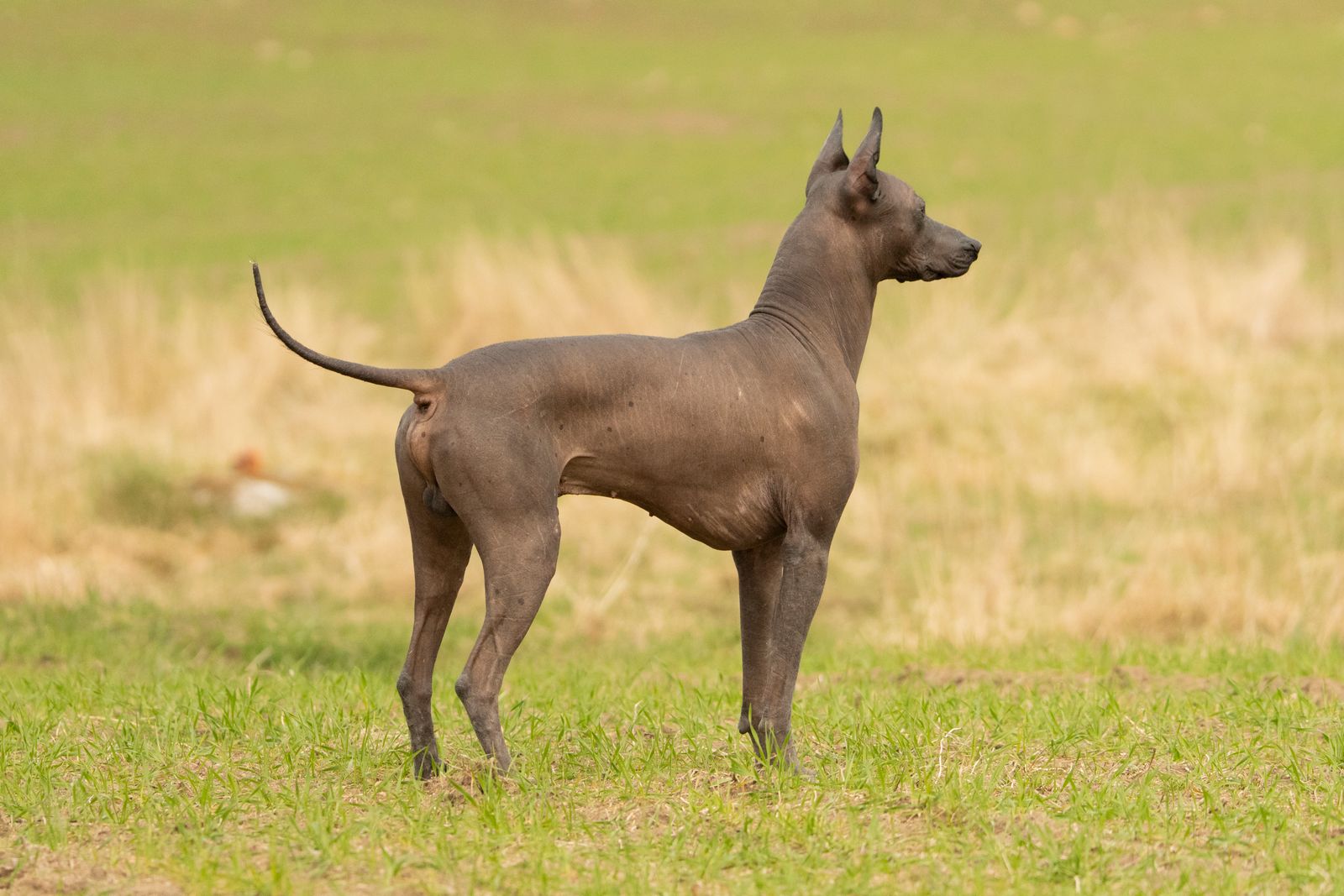
A highly affectionate, highly trainable, great with young children dog. On the practical side: minimal drool and low shedding. The trade-off is high grooming needs.
About the Xoloitzcuintli.
The Xoloitzcuintli (pronounced “show-low-eats-QUEEN-tlee”, or just “show-low” if you prefer the short form most NZ owners use day-to-day) is one of the oldest dog breeds in the Americas, with archaeological records going back over 3,000 years across central and southern Mexico. The breed nearly went extinct in the 20th century, was rescued by a Mexican Kennel Club programme in 1956 that located fewer than ten breeding dogs in remote villages, and is now declared a Mexican national breed. NZ numbers are small but rising, with under 30 NZKC registrations a year and a steady waitlist driven by households seeking lower-allergen breeds.
Adults vary widely by size variety. Toys stand 25 to 36 cm and weigh 4 to 7 kg; miniatures stand 36 to 46 cm at 7 to 14 kg; standards stand 46 to 60 cm at 14 to 25 kg. All three sizes share the same temperament, care routine and breed standard. The hairless variety has skin in slate, black, grey, bronze, liver or red, with sparse hair on the head and tail; the coated variety has a short smooth coat in the same colour range. Lifespan is 13 to 18 years (long for a medium breed), and well-cared-for Xolos in NZ households regularly reach 15 or 16 years.
Personality and behaviour
Xolos are deeply affectionate with their household, calmer than most active breeds and unusually attentive to the routine and mood of the home. The default mode is observational rather than reactive: the dog watches first, decides second, and engages when invited. Most Xolos attach intensely to one or two people but accept the rest of the household easily. They are quieter than most working breeds (a Xolo bark is selective rather than constant) and often described as “cat-like” by NZ owners, in the sense of being clean, quiet and self-contained.
The breed is sociable but selective with strangers. Most Xolos will alert at the door, observe a visitor briefly and warm up over a few minutes. With other dogs the default is friendly when introduced young, civil but reserved when introduced as adults. The breed retains a primitive working temperament and is more thoughtful than impulsive.
The trait that surprises new owners is the trainability. People expect a quirky-looking, decorative dog and find a smart, food-motivated, agility-capable medium dog. The breed responds well to short sessions with reward-based methods and is sensitive to harsh corrections. NZ Xolos compete in agility, rally, scent work and trick training in small numbers, and the breed is one of the more trainable Non Sporting breeds.
The other surprise is the climate sensitivity in the hairless variety. The breed evolved in central Mexico, and the skin handles UV better than a Chinese Crested but still burns in NZ summer sun within 20 to 30 minutes of midday exposure. The cold side is more familiar to NZ owners; Otago winter mornings need a coat for outdoor walks and a fitted jumper indoors below about 18 degrees.
Around children, the breed is patient with calm, considerate older kids. Toddlers are a poor match: the hairless skin is vulnerable to scratches and bumps, the toy size is fragile, and the breed will protest if grabbed. Most NZ breeders prefer households with children seven or older.
Care and exercise
Plan on around 45 minutes of exercise a day, split between two walks and indoor play. The breed is moderately energetic by medium-breed standards: more active than a Bulldog, less driven than a Vizsla. Two 20-minute walks plus a play session and short training cover most adult Xolos. The breed swims well if introduced young and walks happily on harness or lead.
Grooming depends entirely on coat variety. The hairless variety needs skin care, not coat care. Realistic routine:
- Weekly bath with a gentle pH-balanced shampoo (the skin produces oil like human skin and benefits from regular washing).
- Light moisturiser on any dry patches between baths.
- Pet-safe sunscreen (zinc-free, PABA-free) on the back, ears and any exposed skin before extended sun exposure. NZ has the highest UV index in the developed world for parts of summer, and Xolo skin burns within 20 to 30 minutes of midday Auckland or Christchurch sun. Sunscreen is a year-round routine in the upper North Island, not just December through February.
- A fitted jumper indoors below about 18 degrees and a proper coat outdoors below 12 degrees.
- Some hairless Xolos develop adolescent acne (similar to teenage human skin); a vet-prescribed medicated wash usually resolves it.
The coated variety has a short smooth coat that brushes once a week, baths every two to three months and sheds very little (a single soft layer with no big seasonal blow). Both varieties need weekly nail trims and dental care. The hairless gene is linked to incomplete dentition; many hairless Xolos are born with missing premolars or molars, and the teeth that are present are prone to crowding and plaque. A scale-and-polish under anaesthetic every two to three years from age five (NZ$500 to NZ$900 per visit) is typical.
The dietary watch-out is moderate. Both varieties run lean naturally, so the obesity battle is less constant than for many medium breeds, but the breed is prone to food sensitivities and skin reactions to grain-heavy diets in the hairless variety. Persistent itching, recurrent ear infections or chronic acne in the hairless variety often points to a food trigger and a vet-led food trial.
Climate fit across New Zealand
The two varieties handle NZ climate very differently and the hairless variety needs more planning than NZ owners coming from coated breeds expect.
- Auckland and Northland. Manageable for the hairless with planning. UV is the bigger concern than heat; sunscreen on the back and ears year-round, avoid midday walks December through February, and shade outdoor time. The coated variety handles the climate easily; the short coat does not trap heat. Aircon is helpful for both varieties on humid days but not essential.
- Wellington. Excellent for both varieties. Cool summers and breezy days suit the coated variety; the hairless needs a jumper indoors and a coat outdoors below 12 degrees, and Wellington winter is firmly in jumper territory. Wind on southerly days needs a windproof coat for the hairless.
- Christchurch and Canterbury. A good year-round fit for the coated variety. The hairless needs a coat for outdoor walks in winter (frost mornings need indoor jumpers as well) and sunscreen in summer (Canterbury UV is high).
- Central Otago and Southland. A genuine challenge for the hairless variety. The cold cuts through unprotected hairless skin fast; an insulated coat for outdoor walks, a fitted jumper indoors below 18 degrees, a heated dog bed and good house heating are all sensible. The coated variety handles Otago winter without difficulty.
Where to find a Xoloitzcuintli in New Zealand
Three paths.
- Registered NZKC breeders. The Dogs NZ breeders directory lists the small handful of registered Xolo breeders, concentrated in Auckland, Waikato and Canterbury. Expect a 12 to 24 month waitlist and NZ$3,000 to NZ$5,500 per puppy. A reputable breeder shows hip and patella scores for the relevant size variety, ophthalmologist clearances and dental documentation for both parents, and discusses the genetics of the hairless gene openly. Ask whether the litter will include hairless and coated puppies; most do.
- Imports. A small number of NZ owners import Xolos from established Mexican, Australian or US lines through registered breeder networks. Costs run higher (NZ$5,000 to NZ$8,000 with import logistics), waitlists are similar.
- Rescue and SPCA. Pure Xolos are very rare in NZ rescue. The small population means few are surrendered, and surrendered dogs are normally rehomed through breeder networks before reaching SPCA. Standard SPCA fees apply if a Xolo or Xolo-cross does appear (NZ$300 to NZ$600).
The hairless trait is genetically lethal in homozygous form (similar to the Chinese Crested genetic structure), and reputable breeders pair hairless to coated or hairless to hairless with full understanding of the genetics. Online listings without parent photos, registration documentation and breed-club references should be avoided; the small NZ founder population means pedigree verification matters.
The Xoloitzcuintli, by the numbers.
Each trait scored 1 to 5 on the AKC scale. The verdict synthesises the data; the panels below show the strengths, group averages, and the full trait table.
Top strengths
Family Life
avg 4.3Affectionate with Family
Good with Young Children
Good with Other Dogs
Physical
avg 2.0Shedding
Grooming Frequency
Drooling
Social
avg 3.3Openness to Strangers
Playfulness
Watchdog / Protective
Adaptability
Personality
avg 3.0Trainability
Energy Level
Barking Level
Mental Stimulation Needs
Living with a Xoloitzcuintli.
A 24-hour breakdown of how this breed's day typically goes, scaled to its energy, mental-stimulation, and grooming needs.
What a Xoloitzcuintli costs to own.
An indicative NZ lifetime cost: purchase, setup, then food, vet, insurance, grooming and other annual outgoings. Adjust the inputs to see how your choices change the total.
A Xoloitzcuintli costs about
$278per month
$64
$9
$58,076
Adjust the inputs:
Where the monthly cost goes
Food
$78 / mo
$935/yr · breed-appropriate dry & wet food
Insurance
$63 / mo
$761/yr · lifetime cover protects against breed-specific claims
Vet (avg)
$59 / mo
$710/yr · routine checks plus breed-specific risk
Grooming
$40 / mo
$480/yr · brushes, shampoo, professional clips
Other
$38 / mo
$450/yr · toys, treats, dental, boarding
Indicative NZ averages calculated from breed weight, grooming need and screened-condition count. One-off costs (purchase $4,250 + setup $450) are factored into the lifetime total but not the monthly figure.
How does the Xoloitzcuintli compare?
This breed
Xoloitzcuintli
$58,076
16-year lifetime cost
- Purchase + setup$4,700
- Food (lifetime)$14,960
- Vet (lifetime)$11,360
- Insurance (lifetime)$12,176
- Grooming (lifetime)$7,680
- Other (lifetime)$7,200
Reference
Average NZ medium dog
$38,920
12-year lifetime cost
- Purchase + setup$2,200
- Food (lifetime)$13,200
- Vet (lifetime)$6,000
- Insurance (lifetime)$11,400
- Grooming (lifetime)$2,400
- Other (lifetime)$3,720
A Xoloitzcuintli costs about $19,156 more over a lifetime than the average nz medium dog, mostly highervet and highergrooming.
What to ask the breeder.
Reputable NZKC breeders test for these conditions and share results without being prompted. If a breeder won't share screening results, that is itself an answer.
Common
3 conditionsSkin issues (sunburn, acne, allergies)
Specific to the hairless variety. Weekly bath, light moisturiser and sunscreen are routine. NZ UV is among the highest in the developed world and sunburn risk is real.
Dental disease and missing teeth
The hairless gene is linked to incomplete dentition; many hairless Xolos are born with missing premolars or molars. Daily brushing slows plaque on the teeth that are present.
Cold sensitivity (hairless variety)
Not strictly a disease, but a real welfare consideration. Jumper indoors below 18 degrees and a coat outdoors below 12 degrees.
Occasional
3 conditionsPatellar luxation
More common in the toy-size variety. Reputable NZKC breeders score parents.
Hip dysplasia
Most relevant in the standard-size variety. Ask for hip scores from both parents.
Skin cancer (hairless variety)
NZ UV is high. Sunscreen and shaded outdoor time year-round, not just in summer.
The Xoloitzcuintli in NZ.
- Popularity: A rising niche breed in NZ. Under 30 NZKC registrations a year, with most breeders concentrated in Auckland, Waikato and Canterbury. Demand is rising, partly driven by households seeking lower-allergen breeds, partly by the breed''s ancient and unusual look.
- Typical price: NZ$3000–5500 from registered breeders
- Rescue availability: rare
- NZ climate fit: A breed-of-two-climates question. The hairless variety needs sun protection in NZ summer (NZ UV is among the highest in the developed world) and warm clothing in winter. The coated variety handles NZ climate range well. Wellington and Christchurch suit both varieties year-round; Auckland summers need sunscreen discipline; Otago winters need warm clothing for the hairless.
- Living space: Suits apartments and houses well. The 45-minute exercise need is easy to meet on city walks, and the small-to-medium footprint suits flats. The hairless variety is unusually clean indoors (no shed hair on furniture). The breed is quiet by working-dog standards.
Who the Xoloitzcuintli is for.
Suits
- Households with mild dog allergies (the hairless variety releases very low dander)
- Apartment dwellers and retirees
- Households where someone is home most of the day
- Owners willing to manage skin care and sun protection routines
- Households wanting a quiet, low-shedding companion
Less suited to
- Outdoor-only living arrangements
- Households with toddlers or very boisterous young children
- Owners unwilling to apply sunscreen and jumpers as routine
- Cold-climate Otago households without good indoor heating
- Households that want a guard dog or high-energy working partner
Common questions.
How do you pronounce Xoloitzcuintli?
Are Xolos truly hypoallergenic?
Does a Xolo really need sunscreen in NZ?
What size Xolo should I get?
How much does a Xoloitzcuintli puppy cost in NZ?
If the Xoloitzcuintli appeals, also consider.
Breeds with a similar profile that might suit your household.

Chinese Crested Dog
A 4 to 5 kg Toy that comes in two distinct coats (a near-hairless variety with tufted crest, socks and tail plume, and a fully coated "powderpuff" variety) that can appear in the same litter. Affectionate, playful and unusual in care needs, with the hairless variety needing sunscreen, jumpers and warm beds in NZ winter.

Italian Greyhound
The smallest of the sighthounds. A 4 kg miniature Greyhound bred for Mediterranean nobility 2,000 years ago, prized in NZ apartment households for the low shedding, minimal bark and Velcro-dog affection. Genuinely fragile bones; one of the few breeds where leg fractures from ordinary jumps are routine.
Last reviewed:
Sources for this pageInformation only. Breed traits and health notes on this page are aggregated from public registry and breed-authority sources. Individual animals vary; this page is general information, not veterinary, behavioural, or insurance advice. Always consult a registered NZ vet or breeder for guidance specific to your situation.