
Portuguese Water Dog Dog Breed Information
Also known as: Portie, Cao de Agua, PWD
A medium-sized, athletic, low-shedding water retriever from the Portuguese coast. Increasingly popular in NZ for allergy-conscious families and households that want a Poodle-style coat with a sturdier build.
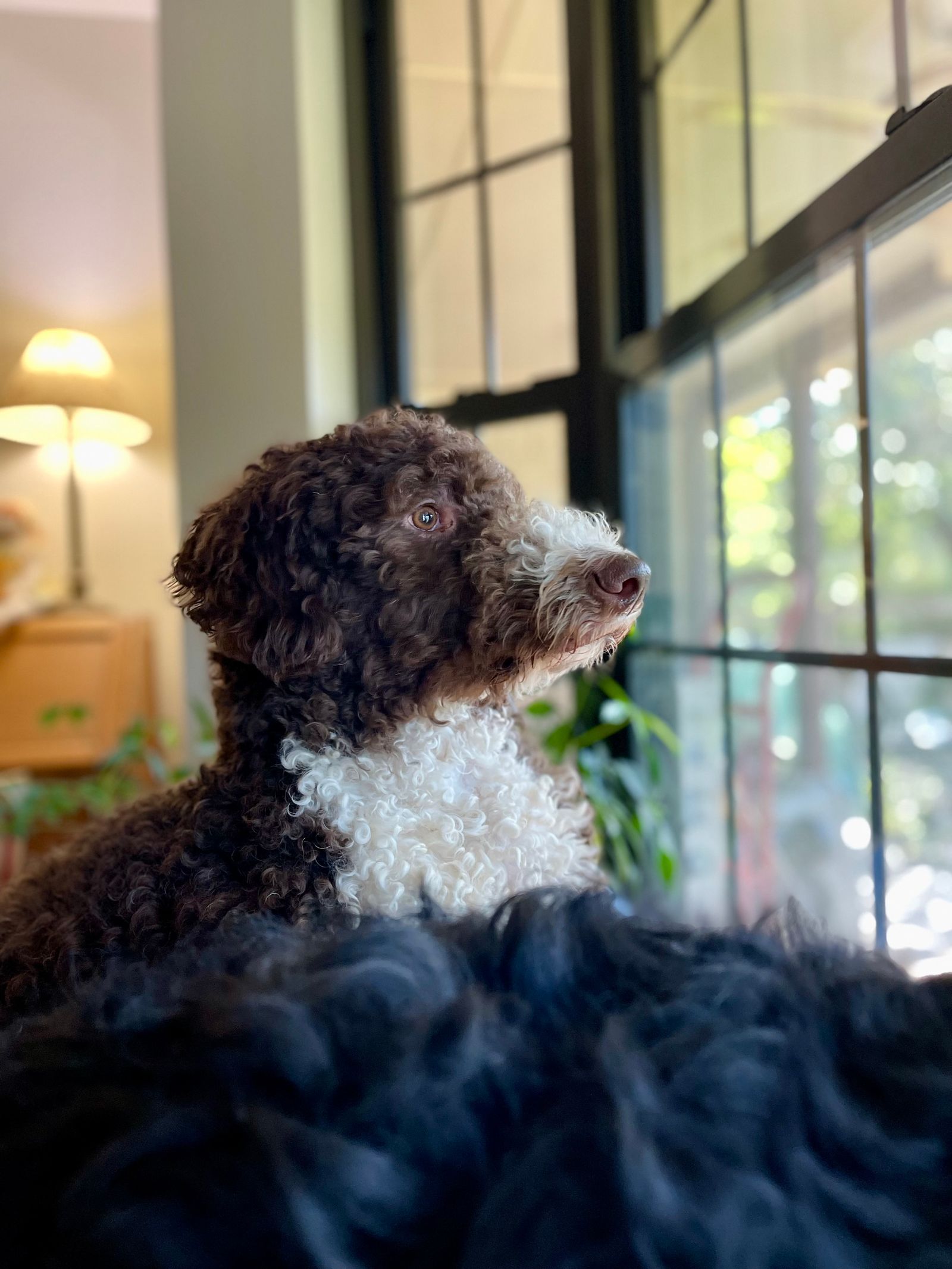
A highly affectionate, highly trainable, great with young children dog. On the practical side: minimal drool and low shedding. The trade-off is high grooming needs.
About the Portuguese Water Dog.
The Portuguese Water Dog is a medium, athletic, low-shedding water retriever bred to work alongside fishermen on the Portuguese coast. In NZ the breed is uncommon but loved, with a steady following among allergy-conscious families and households near water. The Obama family’s choice of Bo and Sunny for the White House drove a real bump in NZ enquiries from 2009 onward, and the small NZKC breeder pool has stayed busy ever since.
Adults stand 43 to 57 cm at the shoulder and weigh 16 to 27 kg, with males commonly at the higher end. The single curly or wavy coat sheds very little and comes in black, white, brown, or partial colours, often with a white blaze on the chest. Lifespan runs 11 to 14 years, longer than most breeds in the giant or large categories.
The trade-off worth naming up front is grooming. The Portie coat does not drop on your floor but it grows continuously and mats against itself if left unbrushed. Plan on a full professional groom every 4 to 6 weeks at NZ$120 to NZ$180, plus three or four brushing sessions a week at home. Owners who learn to clip themselves cut the cost, but no version of Portie ownership is grooming-free.
Personality and behaviour
Portuguese Water Dogs are confident, alert, affectionate dogs with a working dog’s brain and a clown’s sense of humour. They bond closely to their household, are friendly with visitors after the first minute, and read human cues unusually well. They are not natural guard dogs; they will alert and look impressive at full coat, but the default reaction to a stranger is curiosity.
The defining behavioural feature is the brain. Porties are problem-solvers in the same way Border Collies and Standard Poodles are problem-solvers. They learn how doors and latches work, where the treats live, and which family member is the soft touch. Underemployed Porties get inventive: tipping bins, opening cupboards, redesigning the garden. The breed wants a job in the same way a working dog wants a job, just dressed in better hair.
They are sensitive. PWDs read tone and body language closely and shut down on harsh handling. The flip side is they respond brilliantly to clear, kind training and pick up complex behaviours fast. Many NZ Porties compete at NZKC obedience and agility events.
What surprises new owners is the intensity. Porties are not couch dogs in the way a Lab can settle into a couch dog by age four. The breed retains drive and playfulness well into adulthood, and an adult Portie still wants the same swim, the same retrieve, the same brain task at age eight that it wanted at two. Owners who match the energy do brilliantly. Owners who expected a calm low-allergen lapdog regret the choice fast.
Vocalising is moderate. Porties bark to alert, to play, and (the breed’s distinctive trait) to communicate. The original fishing dogs were used to bark across boats; the modern breed retains a noticeably broad vocal range with growls, mumbles and yips that aren’t standard pet-dog sounds. Most settle quickly when given context.
Care and exercise
Plan on around 75 minutes of exercise a day, with at least one session involving swimming or hard retrieve work. Daily structure beats one big weekend hit. The breed is at its best with regular water access (a beach, a lake, even a creek on a lifestyle block).
Grooming is the input most owners underestimate. Realistic options:
- Professional groom every 4 to 6 weeks at NZ$120 to NZ$180 in Auckland, Wellington or Christchurch, plus brushing three to four times a week at home with a slicker brush and metal comb.
- Clip at home with a NZ$200 to NZ$400 set of clippers and learn the cuts. Saves NZ$1,500 a year. Still needs home brushing and a groomer for the awkward bits (face, feet, sanitary) two or three times a year.
- Skip grooming and the next visit is a clip-down. Some NZ Portie owners just keep the dog short year-round, especially summer. Honest, less photogenic.
Ear care matters more than for most breeds. Drop ears plus heavy water exposure means routine post-swim cleaning and drying. Hair grows inside the ear canal and routine groomers pluck and clean it; ask the first time. Untreated, ear infections become a chronic claim category.
Diet watch-outs are limited. The breed is athletic and easier to keep lean than a Lab. Adults do well on 200 to 350 g of quality dry food a day, split into two meals. Watch portion creep on rest days.
Climate fit across New Zealand
The Portuguese Water Dog handles a wider climate range than people expect, and the curly coat insulates well at length.
- Auckland and Northland. A natural fit. The mild climate suits the breed year-round and beach access is a cheat code; most upper North Island Porties swim weekly through summer. Clip the coat shorter through January and February to manage humidity. Keep midday walks short above 25 degrees.
- Wellington. A natural fit too. The breed handles wind, rain and rough harbour swims without complaint. Wet curly coats take longer to dry than smooth coats; a microfibre towel and a heated indoor space matter more than they do for a Lab.
- Christchurch and Canterbury. Comfortable across both seasons. A clipped Portie does need a coat for early-morning Christchurch July walks; an unclipped Portie handles Canterbury winter better than people assume. Lake Coleridge, Wakipuaka and the Avon all work as swim spots through summer.
- Central Otago and Southland. Doable, with the coat kept longer through winter. The original Portuguese fishing dogs worked the cold Atlantic; cold water itself is not a problem. Indoor sleeping in winter is standard.
Where to find a Portuguese Water Dog in New Zealand
Three reasonable paths.
- Registered NZKC breeders. The Dogs NZ breeders directory lists registered Portuguese Water Dog breeders. Numbers are small (a handful of active kennels), mostly in the upper North Island. Expect a 8 to 18 month waitlist for a litter and NZ$2,500 to NZ$4,500 per puppy. Ask for hip scores under 10 each, prcd-PRA and GM1 DNA results, juvenile dilated cardiomyopathy DNA results, and parent temperament you can meet in person.
- Breed-specific rescue. Rare in NZ given the small national population. Adults occasionally surrender through breeder networks after life changes; the breed club is the right first contact. Adoption fees run NZ$500 to NZ$1,000 and most rescue Porties have known histories.
- SPCA NZ. Pure Porties almost never come through. Portie crosses (often Portie x Poodle, sometimes Portie x Lab) appear occasionally and need temperament assessment.
Avoid breeders selling Portuguese Water Dogs as part of a “doodle” line, anyone offering “rare” colours at premiums, and any breeder unwilling to show parent health screening in writing. The breed’s small NZ gene pool makes informed breeder choice especially important. The Portuguese Water Dog Club of NZ (where active) is the right port for referrals.
Insurance and lifetime cost
Portuguese Water Dog insurance claims in NZ tend to cluster around hip and joint issues, ear infections (water work is a tax on ears), and the occasional Addison’s or cardiac diagnosis. Three things shape the premium:
- Lifetime cover. Porties live 11 to 14 years and the chronic conditions on the breed list (Addison’s, cardiac, prcd-PRA) reward lifetime cover with no per-condition cap. Annual difference over accident-only: roughly NZ$300 to NZ$600.
- Sub-limits per condition. Hip surgery runs NZ$5,000 to NZ$12,000 per side. Cardiac monitoring runs NZ$1,500 to NZ$3,000 a year if a condition develops. A NZ$5,000 sub-limit exhausts fast.
- Grooming is not insured. The NZ$1,800 to NZ$2,400 a year of professional grooming is on you, not the insurer.
For a typical NZ Portie on a mid-range lifetime policy, lifetime cost (purchase plus 12 to 14 years of food, vet, insurance, registration, grooming and incidentals) sits around NZ$30,000 to NZ$45,000. Grooming alone adds NZ$20,000 to NZ$28,000 across a lifetime if done professionally.
The Portuguese Water Dog, by the numbers.
Each trait scored 1 to 5 on the AKC scale. The verdict synthesises the data; the panels below show the strengths, group averages, and the full trait table.
Top strengths
Family Life
avg 4.7Affectionate with Family
Good with Young Children
Good with Other Dogs
Physical
avg 2.3Shedding
Grooming Frequency
Drooling
Social
avg 4.0Openness to Strangers
Playfulness
Watchdog / Protective
Adaptability
Personality
avg 4.3Trainability
Energy Level
Barking Level
Mental Stimulation Needs
Living with a Portuguese Water Dog.
A 24-hour breakdown of how this breed's day typically goes, scaled to its energy, mental-stimulation, and grooming needs.
What a Portuguese Water Dog costs to own.
An indicative NZ lifetime cost: purchase, setup, then food, vet, insurance, grooming and other annual outgoings. Adjust the inputs to see how your choices change the total.
A Portuguese Water Dog costs about
$333per month
$77
$11
$55,846
Adjust the inputs:
Where the monthly cost goes
Food
$95 / mo
$1,145/yr · breed-appropriate dry & wet food
Insurance
$74 / mo
$887/yr · lifetime cover protects against breed-specific claims
Vet (avg)
$59 / mo
$710/yr · routine checks plus breed-specific risk
Grooming
$67 / mo
$800/yr · brushes, shampoo, professional clips
Other
$38 / mo
$450/yr · toys, treats, dental, boarding
Indicative NZ averages calculated from breed weight, grooming need and screened-condition count. One-off costs (purchase $3,500 + setup $450) are factored into the lifetime total but not the monthly figure.
How does the Portuguese Water Dog compare?
This breed
Portuguese Water Dog
$55,846
13-year lifetime cost
- Purchase + setup$3,950
- Food (lifetime)$14,885
- Vet (lifetime)$9,230
- Insurance (lifetime)$11,531
- Grooming (lifetime)$10,400
- Other (lifetime)$5,850
Reference
Average NZ medium dog
$38,920
12-year lifetime cost
- Purchase + setup$2,200
- Food (lifetime)$13,200
- Vet (lifetime)$6,000
- Insurance (lifetime)$11,400
- Grooming (lifetime)$2,400
- Other (lifetime)$3,720
A Portuguese Water Dog costs about $16,926 more over a lifetime than the average nz medium dog, mostly highergrooming and highervet.
What to ask the breeder.
Reputable NZKC breeders test for these conditions and share results without being prompted. If a breeder won't share screening results, that is itself an answer.
Common
1 conditionEar infections
Drop ears plus heavy water exposure equals routine post-swim drying and cleaning.
Occasional
3 conditionsHip dysplasia
Reputable NZ breeders score parents through Dogs NZ; ask for hip results under 10 each.
Progressive retinal atrophy (prcd-PRA)
DNA test is available and used routinely by ethical breeders.
Addison's disease
An occasional condition in the Portuguese Water Dog. Worth asking about and DNA testing where available.
Rare but urgent
2 conditionsGM1 storage disease
Fatal genetic condition that DNA testing has nearly eliminated from reputable lines. Ask for clear results on both parents.
Juvenile dilated cardiomyopathy
Breed-specific form. DNA marker test now available.
The Portuguese Water Dog in NZ.
- NZ popularity: ranked #95
- Popularity: Small but stable NZKC presence, a few hundred dogs nationally. Concentrated in Auckland, Wellington and Christchurch, where allergy-conscious households and proximity to water both favour the breed.
- Typical price: NZ$2500–4500 from registered breeders
- Rescue availability: rare
- NZ climate fit: Bred for the Atlantic coast; built for water in any temperature. Handles the full NZ climate range comfortably. Loves swimming, which is most of the year on upper North Island beaches and most of the summer in the south.
- Living space: Adapts to apartment, house or lifestyle block. Daily exercise plus regular swimming is the formula; the breed underperforms in homes with no access to water and no time for a real walk.
Who the Portuguese Water Dog is for.
Suits
- Households with allergies or low tolerance for shedding
- Active families near water (beaches, lakes, harbours)
- Owners who can budget for regular professional grooming
Less suited to
- Owners who refuse to groom or pay for grooming
- Households where the dog is left alone for long workdays
- Anyone wanting a low-input dog
Common questions.
Are Portuguese Water Dogs really hypoallergenic?
How is a Portuguese Water Dog different from a Standard Poodle?
How much does a Portuguese Water Dog cost in NZ?
If the Portuguese Water Dog appeals, also consider.
Breeds with a similar profile that might suit your household.

Poodle (Standard)
A large, athletic, low-shedding water retriever. One of the most trainable breeds in the world and a steady favourite among NZ owners with allergies or a preference for a clean-floored house.

Irish Water Spaniel
The tallest of the spaniel breeds and the oldest of the Irish gundogs. Distinctive curly liver-coloured coat with a smooth "rat tail" and a topknot of curls. Very rare in NZ, suiting experienced gundog and active rural homes.
Last reviewed:
Sources for this pageInformation only. Breed traits and health notes on this page are aggregated from public registry and breed-authority sources. Individual animals vary; this page is general information, not veterinary, behavioural, or insurance advice. Always consult a registered NZ vet or breeder for guidance specific to your situation.