
Greater Swiss Mountain Dog Dog Breed Information
Also known as: Swissy, Grosser Schweizer Sennenhund, GSMD
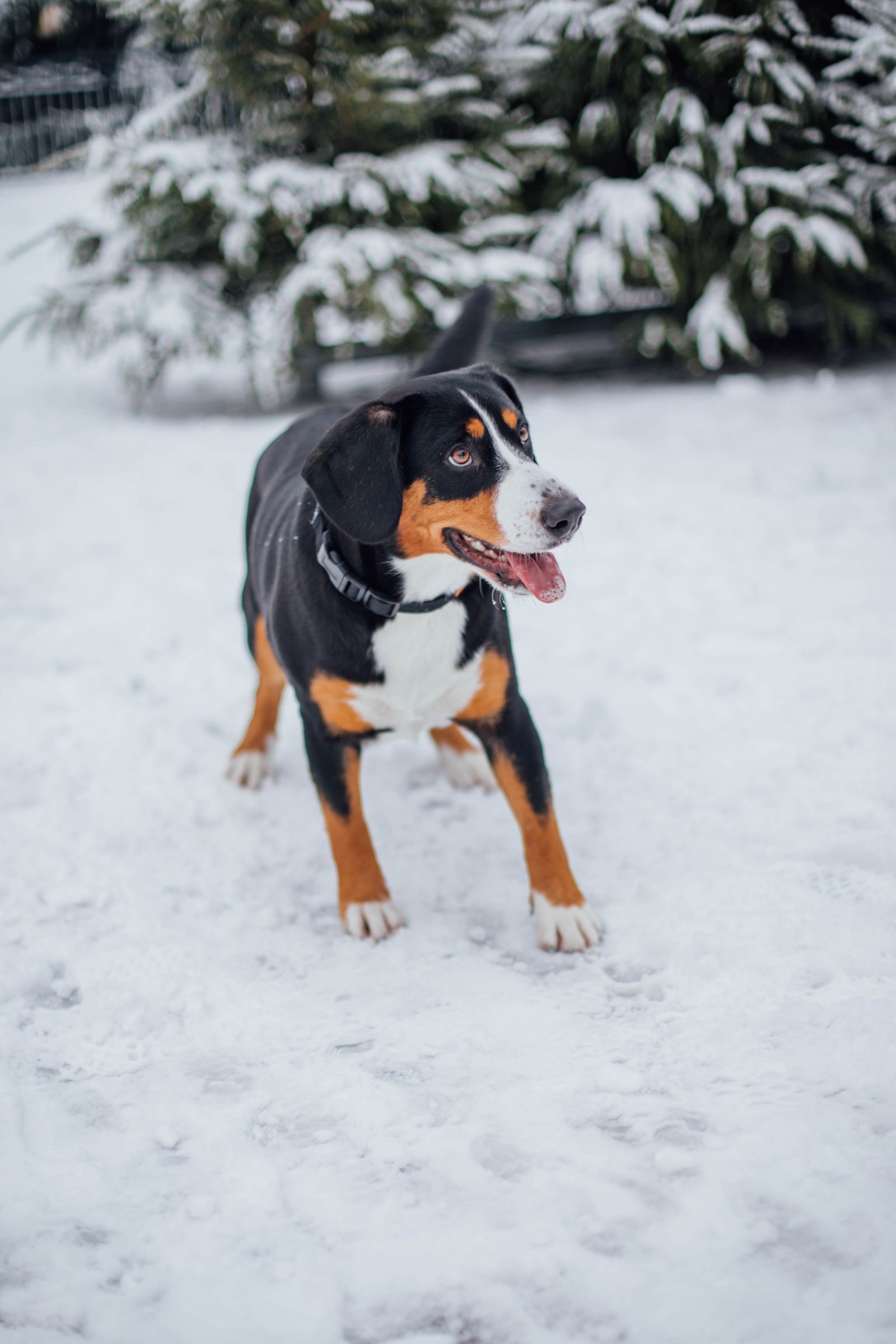
The largest and oldest of the Swiss Sennenhund breeds. A short-coated, draft-and-drove working dog with the same tricolour pattern as the Bernese but a longer lifespan, more energy, and far less grooming.
A highly affectionate, highly trainable, great with young children dog. On the practical side: low grooming demands. The trade-off is sheds plenty.
About the Greater Swiss Mountain Dog.
The Greater Swiss Mountain Dog is the largest and oldest of the four Swiss Sennenhund breeds, with the same tricolour pattern as its better-known cousin the Bernese Mountain Dog but a short coat, a longer lifespan, and a noticeably more energetic temperament. NZ numbers are small (lower than the Bernese), with most Swissies on lifestyle blocks and rural sections across Otago, Canterbury, Wellington and the central North Island. Owners considering a giant Swiss breed but put off by the Bernese grooming load and short lifespan often land on the Swissy.
Adults stand 60 to 72 cm at the shoulder and weigh 39 to 64 kg, with males consistently larger than females. The coat is short, dense and weather-resistant, only ever in the breed standard tricolour: jet black with rich rust markings on the legs, chest and face, and clean white on the chest, paws, blaze and tail tip. The colour pattern is identical to the Bernese; the obvious difference at a glance is the coat length.
Personality and behaviour
Swissies are confident, family-oriented working dogs. They bond closely to their household, are friendly with familiar visitors, and watchful but not aggressive with strangers. The breed alerts on real triggers and goes back to whatever it was doing afterwards. Around children of the household the temperament is patient and tolerant; the protective instinct presents as positioning rather than escalation.
The trait that surprises new owners coming from the Bernese is the energy level. The Swissy is a working draft-and-drove breed and needs more daily exercise and mental engagement than its long-coated cousin. Sixty to ninety minutes of activity a day is the realistic baseline, ideally split across two walks plus calm off-lead time on a lifestyle block or in a secure paddock. Underexercised Swissies become bored and noisy in their teen months, a phase that runs from 12 to 24 months and tests new owners.
Around other dogs the breed is typically sociable with familiar housemates and well-mannered with strangers on lead. Same-sex pairs of intact adults can clash; most NZKC breeders place puppies into single-dog or mixed-sex homes. Multi-dog households work fine when introductions are managed early.
The breed is moderately vocal. The deep alert bark is unmistakeable; nuisance barking is uncommon in well-exercised dogs. Like the Bernese, the Swissy is a velcro dog at home and does not cope being left alone in the back yard for long workdays. NZ rescues see Swissies surrendered for separation-related destruction that is almost always loneliness in disguise.
Care and exercise
Plan on around 75 minutes of moderate exercise a day for an adult, split between two walks. The breed is built for slow, steady draft work and thrives on long lifestyle-block walks, structured hikes once growth plates close, and water access in summer. Forced running, stair sprinting and hard fetch are wrong for the breed under 18 to 24 months and risk elbow dysplasia, OCD lesions and joint pain.
Grooming is the standout advantage over the Bernese. The short double coat needs a weekly brush with a slicker or rubber curry, daily brushing for two to three weeks during the spring and autumn coat blow, and a bath every six to eight weeks. The coat dries quickly after rain or a paddock romp; tangles and mats are not part of the routine. Drool is moderate, not Mastiff-level.
The dietary priority is controlled growth and bloat management. Use a giant-breed puppy formula until 18 to 24 months. Adults eat 4 to 7 cups a day split into two meals. Single large meals raise gastric torsion risk. Splenic torsion is a recognised breed-specific emergency: sudden collapse with abdominal distension is a same-day vet visit, not a wait-and-see.
Many NZ Swissy owners arrange prophylactic gastropexy at desexing. The procedure (NZ$1,200 to NZ$2,500) tacks the stomach to the body wall and reduces twist risk to nearly zero. Compared with emergency GDV surgery (NZ$6,000 to NZ$12,000), it is meaningfully cheaper and life-saving.
Climate fit across NZ favours the cooler regions. Central Otago and Southland match the breed’s alpine origin closely, with cold winters and dry summers. Christchurch, Canterbury and Wellington suit well year-round. Auckland and Northland summers above 26 degrees with overnight humidity are the hardest fit; aircon, shade, paddling pools and walks at dawn or after 7 pm in January and February are the basics. The short coat helps more than the Bernese long coat but does not eliminate the heat-management requirement.
Where to find a Swissy in New Zealand
Three paths, in order of typical preference.
- Registered NZKC breeders. The Dogs NZ breeders directory lists the small group of registered NZKC Swissy breeders. Litters are infrequent; expect 12 to 24 month waitlists for puppies from health-tested parents at NZ$3,000 to NZ$5,500. Reputable breeders will show you hip and elbow scores, eye certification and ideally cancer-line history on both parents, ask about your fencing, work hours and prior dog experience, and decline placements they judge wrong.
- Breed-specific contacts. The Bernese Mountain Dog Club of New Zealand and Australian Swissy networks occasionally coordinate rehoming of adolescent or adult dogs surrendered by under-prepared owners. Adoption fees run NZ$400 to NZ$1,000.
- SPCA NZ. Pure Swissies are very rare in SPCA centres. Mountain-dog crosses appear occasionally; temperament assessment matters more than pedigree at that stage.
Avoid Trade Me listings without parent health screening, “miniature Swissy” advertisements (a fashion crossbreed, not the recognised breed), and any breeder who cannot show you the dam in person. The small NZ gene pool makes informed breeder choice especially important for a giant breed with hereditary joint and bloat risks.
Insurance and lifetime cost
Swissy insurance claims in NZ cluster around orthopaedic conditions (cruciate rupture, hip and elbow dysplasia), bloat, splenic torsion and cardiac care. The longer lifespan compared with the Bernese spreads cost across more years rather than reducing it. Lifetime cover with no per-condition cap rewards the breed’s chronic-condition risk profile; cruciate cover and bloat-related surgery cover are worth confirming on policy intake. For a typical NZ Swissy on a mid-range lifetime policy, lifetime cost (purchase plus 9 to 12 years of food, vet, insurance, council registration, beds and gear) lands around NZ$40,000 to NZ$65,000.
The Greater Swiss Mountain Dog, by the numbers.
Each trait scored 1 to 5 on the AKC scale. The verdict synthesises the data; the panels below show the strengths, group averages, and the full trait table.
Top strengths
Family Life
avg 4.7Affectionate with Family
Good with Young Children
Good with Other Dogs
Physical
avg 3.0Shedding
Grooming Frequency
Drooling
Social
avg 3.8Openness to Strangers
Playfulness
Watchdog / Protective
Adaptability
Personality
avg 3.5Trainability
Energy Level
Barking Level
Mental Stimulation Needs
Living with a Greater Swiss Mountain Dog.
A 24-hour breakdown of how this breed's day typically goes, scaled to its energy, mental-stimulation, and grooming needs.
What a Greater Swiss Mountain Dog costs to own.
An indicative NZ lifetime cost: purchase, setup, then food, vet, insurance, grooming and other annual outgoings. Adjust the inputs to see how your choices change the total.
A Greater Swiss Mountain Dog costs about
$399per month
$92
$13
$57,412
Adjust the inputs:
Where the monthly cost goes
Food
$170 / mo
$2,045/yr · breed-appropriate dry & wet food
Insurance
$119 / mo
$1,427/yr · lifetime cover protects against breed-specific claims
Vet (avg)
$64 / mo
$770/yr · routine checks plus breed-specific risk
Grooming
$8 / mo
$100/yr · brushes, shampoo, professional clips
Other
$38 / mo
$450/yr · toys, treats, dental, boarding
Indicative NZ averages calculated from breed weight, grooming need and screened-condition count. One-off costs (purchase $4,250 + setup $450) are factored into the lifetime total but not the monthly figure.
How does the Greater Swiss Mountain Dog compare?
This breed
Greater Swiss Mountain Dog
$57,412
11-year lifetime cost
- Purchase + setup$4,700
- Food (lifetime)$22,495
- Vet (lifetime)$8,470
- Insurance (lifetime)$15,697
- Grooming (lifetime)$1,100
- Other (lifetime)$4,950
Reference
Average NZ medium dog
$38,920
12-year lifetime cost
- Purchase + setup$2,200
- Food (lifetime)$13,200
- Vet (lifetime)$6,000
- Insurance (lifetime)$11,400
- Grooming (lifetime)$2,400
- Other (lifetime)$3,720
A Greater Swiss Mountain Dog costs about $18,492 more over a lifetime than the average nz medium dog, mostly higherfood and higherinsurance.
What to ask the breeder.
Reputable NZKC breeders test for these conditions and share results without being prompted. If a breeder won't share screening results, that is itself an answer.
Common
2 conditionsHip and elbow dysplasia
Ask breeders for hip and elbow scores on both parents.
Bloat (gastric dilatation-volvulus)
Deep-chested giant; feed twice daily and avoid hard exercise around meals. Prophylactic gastropexy at desexing is a recognised option.
Occasional
5 conditionsSplenic torsion
A breed-specific surgical emergency; sudden collapse and abdominal distension warrant immediate vet attention.
Epilepsy
An occasional condition in the Greater Swiss Mountain Dog. Worth asking about and DNA testing where available.
Osteochondrosis (OCD) of the shoulder
Linked to fast growth in giant-breed puppies. Feed a giant-breed puppy formula and avoid forced jumping under 18 months.
Urinary incontinence in spayed females
An occasional condition in the Greater Swiss Mountain Dog. Worth asking about and DNA testing where available.
Cruciate ligament rupture
An occasional condition in the Greater Swiss Mountain Dog. Worth asking about and DNA testing where available.
The Greater Swiss Mountain Dog in NZ.
- Popularity: A small, niche presence in NZKC Utility registrations, mostly on lifestyle blocks and rural sections in Otago, Canterbury, Wellington and the central North Island. Numbers run lower than the Bernese in NZ.
- Typical price: NZ$3000–5500 from registered breeders
- Rescue availability: rare
- NZ climate fit: Built for alpine Switzerland: cold tolerance is excellent and snow is no issue. The short double coat handles winter rain and frost well and dries quickly. Heat management matters in upper North Island summers, though the short coat helps more than the Bernese long coat.
- Living space: Needs a fenced yard and indoor cool space. The breed bonds tightly to family and does not cope being left alone in the back yard for long workdays.
Who the Greater Swiss Mountain Dog is for.
Suits
- Active families with space and a fenced yard
- Owners wanting a large Swiss working breed without the Bernese coat workload
- Cooler regions like Otago, Canterbury, Wellington and the central North Island
Less suited to
- Apartments and small townhouses
- Hot, humid Auckland and Northland summers without shade and aircon
- Sedentary households expecting a low-energy giant
Common questions.
How is the Greater Swiss Mountain Dog different from the Bernese?
How long do Greater Swiss Mountain Dogs live in NZ?
How much does a Greater Swiss Mountain Dog cost in New Zealand?
Can a Swissy cope with an Auckland summer?
If the Greater Swiss Mountain Dog appeals, also consider.
Breeds with a similar profile that might suit your household.

Bernese Mountain Dog
Big, calm, tricolour Swiss working dog with a thick double coat. Affectionate at home, slow to mature, and noticeably short-lived for the cost and commitment.

Saint Bernard
Giant Alpine rescue and farm dog, calm, affectionate, and famous for the brandy-barrel myth that turns out not to be true. Drools heavily, sheds heavily, and lives a short life for the cost.

Newfoundland
Massive water-rescue dog with a thick oily double coat, webbed feet, and one of the gentlest temperaments of any working breed. Drools, sheds, and lives a relatively short life, but devoted to family.

Rottweiler
A powerful, confident working dog with a deep bond to its household. Rottweilers are calm and steady when raised right, and a serious responsibility when not.
Last reviewed:
Sources for this pageInformation only. Breed traits and health notes on this page are aggregated from public registry and breed-authority sources. Individual animals vary; this page is general information, not veterinary, behavioural, or insurance advice. Always consult a registered NZ vet or breeder for guidance specific to your situation.