
Gordon Setter Dog Breed Information
Also known as: Black and Tan Setter
The black-and-tan Scottish setter. Larger and more substantial than the English or Irish, with a steadier working pace and a more protective edge. Held by a small NZ following across active suburban and gundog households.
A highly affectionate, highly trainable, great with young children dog. On the practical side: minimal drool. The trade-off is high grooming needs.
About the Gordon Setter.
The Gordon Setter is the largest and most substantial of the British setters, the black-and-tan Scottish member of the family. The breed sits in a small but steady NZ following, mostly across active suburban families, lifestyle-block households and a handful of gundog homes who value the breed’s stamina, watchful edge and slower working pace.
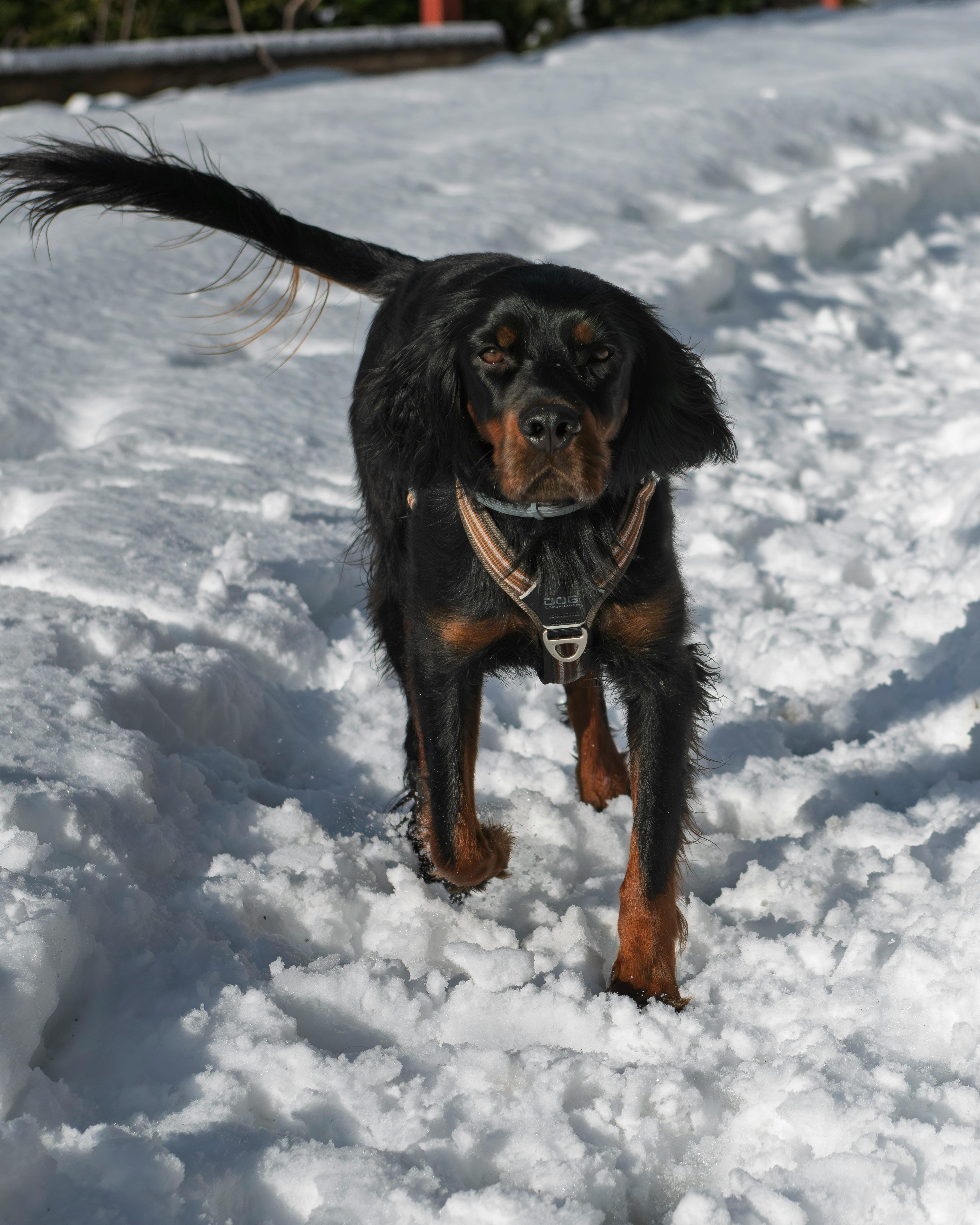
Adults stand 58 to 69 cm at the shoulder and weigh 20 to 36 kg, with the higher end of that weight range pulling clear of the English and Irish Setters. The single silky coat is long and feathered on legs, chest, ears, belly and tail, and the colour is fixed: deep black with rich chestnut tan markings on the muzzle, above the eyes, on the chest and legs, and under the tail. Lifespan is 10 to 13 years, slightly shorter than the lighter setters.
The signal that defines daily life with a Gordon is steady stamina with a watchful edge. Where the Irish Setter is fast and joyfully distractable and the English is calm and rhythmic, the Gordon is a long-haul working dog with more reserve toward strangers and a stronger bond to the family. The breed reads as a more “serious” setter, both in working style and in household manner.
Personality and behaviour
Gordon Setters are deeply affectionate with the household and good with other dogs. With strangers the breed is more reserved than the English or Irish, polite at first meeting rather than openly enthusiastic. That reserve is part of why the Gordon historically has a slight protective edge that the other setters lack; the breed will alert and place itself between the family and an unfamiliar visitor in a way an Irish Setter rarely does.
Around children the breed is gentle and patient with family kids and tolerant of normal handling. The size and energy mean a fast-moving adolescent can knock toddlers over without meaning to; supervise interactions until the dog has learned its body around age two.
The trait that surprises new owners is the long puppy phase. Mental adolescence in the Gordon runs through to age three, slightly shorter than the Irish Setter but still longer than most retrievers. A six-month-old Gordon is a teenager, an 18-month-old is a confident teenager, and a three-year-old is finally settling. Owners who expect Labrador-pace maturity feel they have a faulty dog; they don’t, the breed just takes longer.
The breed is sensitive. Harsh handling shuts a Gordon down quickly and the dog remembers it. Reward-based training is the only sensible approach.
The bond is intense. Gordons are famously devoted to their primary handler in a way the English and Irish are not, and many owners describe a low-grade separation anxiety that needs management. Daycare, lunchtime walkers or work-from-home households suit the breed better than long workdays alone.
Care and exercise
Plan on 75 to 90 minutes of exercise per day, with real off-lead running on safe ground. The breed needs to gallop, scent and problem-solve. Tramping, beach running, retrieve work, scent games and gundog training all suit the breed. A 30-minute on-lead walk twice a day is enough to maintain weight but not enough to satisfy the underlying drive, and an underexercised Gordon becomes restless, mouthy and destructive.
Grooming is committed. Brush two to three times a week through the long feathering, book a pet clip every 8 to 10 weeks (NZ$80 to NZ$130), and daily-brush during the spring and autumn coat blow. Show-coat owners groom daily and bath weekly. After paddock, beach and rural walks, check ears (the long-feathered dropped ear is the classic moisture and grass-seed trap) and clear seeds from feet and behind ears in summer. The black coat shows mud less than the white-coated setters but every grass seed shows clearly when you look for it.
Bloat is a real risk. The deep chest and lean build predispose the breed to gastric dilatation-volvulus, a fast-onset surgical emergency. Feed two smaller meals a day, avoid heavy exercise within an hour of meals, and learn the early signs (unproductive retching, distended belly, restlessness, drooling). Several NZ insurers see bloat claims as the highest single-event cost in setter breeds.
Ear care is a lifetime job. Recurring ear infections are one of the more common claim types on NZ pet insurance for the breed. Check after every walk, dry thoroughly after swims and rain, and act fast at any sign of head shaking, smell or scratching.
Watch the weight. Pet-line Gordons carry weight readily; the long-backed setter frame does not tolerate overload well.
Where to find a Gordon Setter in New Zealand
Three reasonable paths.
- Registered NZKC breeders. The Dogs NZ breeders directory lists the small number of registered Gordon Setter breeders. National litters are infrequent. Expect a 12 to 18 month waitlist, NZ$2,500 to NZ$4,000 per puppy, and full parent health screening (hip and elbow scores, eye certificates, rcd4-PRA and cerebellar ataxia DNA results).
- NZ Gundog Trial Association contacts. Working Gordon Setter litters appear occasionally through the trial and gundog community. Numbers are small; most working-line dogs in NZ trace to imported pedigrees.
- Rescue. Pure Gordon Setter surrenders are uncommon at SPCA but appear a few times a year, often adolescent dogs whose owners underestimated the energy and grooming. Adoption fees NZ$300 to NZ$700.
Avoid Trade Me listings without parent health screening, and any breeder who can’t show you the dam in person. Confident, calm parent dogs are the strongest single signal you can take from a breeder visit; the breed’s protective edge can drift toward nervous reactivity in poorly-bred lines.
Climate fit and household fit
The long single coat handles the full NZ climate range, with regional watch-points. Auckland and Northland summer heat is the main concern because the dark coat absorbs heat readily; walk early or late, avoid midday December through February, and use sea or river swims to cool the dog. Wellington wet, windy weather is workable; towel down thoroughly after wet walks. Christchurch and Canterbury cold winters are no issue and the plains, Port Hills and Banks Peninsula suit the breed. Central Otago and Southland are an excellent fit for the breed’s stamina and cold tolerance.
The Gordon suits an active suburban or rural household with adults or older children, time for grooming, and the patience for a three-year puppy phase. The breed does not fit first-time owners wanting a quick-settling dog, apartment living without serious daily exercise, or households where the dog is left alone for long workdays. For owners who match the breed well, the Gordon is one of the most devoted large dogs you can live with.
The Gordon Setter, by the numbers.
Each trait scored 1 to 5 on the AKC scale. The verdict synthesises the data; the panels below show the strengths, group averages, and the full trait table.
Top strengths
Family Life
avg 4.3Affectionate with Family
Good with Young Children
Good with Other Dogs
Physical
avg 2.7Shedding
Grooming Frequency
Drooling
Social
avg 3.5Openness to Strangers
Playfulness
Watchdog / Protective
Adaptability
Personality
avg 3.5Trainability
Energy Level
Barking Level
Mental Stimulation Needs
Living with a Gordon Setter.
A 24-hour breakdown of how this breed's day typically goes, scaled to its energy, mental-stimulation, and grooming needs.
What a Gordon Setter costs to own.
An indicative NZ lifetime cost: purchase, setup, then food, vet, insurance, grooming and other annual outgoings. Adjust the inputs to see how your choices change the total.
A Gordon Setter costs about
$337per month
$78
$11
$52,228
Adjust the inputs:
Where the monthly cost goes
Food
$112 / mo
$1,340/yr · breed-appropriate dry & wet food
Insurance
$84 / mo
$1,004/yr · lifetime cover protects against breed-specific claims
Vet (avg)
$64 / mo
$770/yr · routine checks plus breed-specific risk
Grooming
$40 / mo
$480/yr · brushes, shampoo, professional clips
Other
$38 / mo
$450/yr · toys, treats, dental, boarding
Indicative NZ averages calculated from breed weight, grooming need and screened-condition count. One-off costs (purchase $3,250 + setup $450) are factored into the lifetime total but not the monthly figure.
How does the Gordon Setter compare?
This breed
Gordon Setter
$52,228
12-year lifetime cost
- Purchase + setup$3,700
- Food (lifetime)$16,080
- Vet (lifetime)$9,240
- Insurance (lifetime)$12,048
- Grooming (lifetime)$5,760
- Other (lifetime)$5,400
Reference
Average NZ medium dog
$38,920
12-year lifetime cost
- Purchase + setup$2,200
- Food (lifetime)$13,200
- Vet (lifetime)$6,000
- Insurance (lifetime)$11,400
- Grooming (lifetime)$2,400
- Other (lifetime)$3,720
A Gordon Setter costs about $13,308 more over a lifetime than the average nz medium dog, mostly highergrooming and highervet.
What to ask the breeder.
Reputable NZKC breeders test for these conditions and share results without being prompted. If a breeder won't share screening results, that is itself an answer.
Common
3 conditionsHip dysplasia
Larger setter; ask breeders for hip scores from both parents.
Bloat (gastric dilatation-volvulus)
Deep-chested breed; feed twice daily, avoid heavy exercise around meals, and learn the early signs.
Ear infections
Long-feathered dropped ears trap moisture and grass seeds, particularly after rural walks and swimming.
Occasional
3 conditionsElbow dysplasia
An occasional condition in the Gordon Setter. Worth asking about and DNA testing where available.
Progressive retinal atrophy (rcd4-PRA)
DNA-testable; reputable NZ breeders screen before mating.
Hypothyroidism
An occasional condition in the Gordon Setter. Worth asking about and DNA testing where available.
Rare but urgent
1 conditionCerebellar ataxia
DNA-testable hereditary neurological condition specific to the breed; reputable breeders screen.
The Gordon Setter in NZ.
- Popularity: A small but steady breed in NZ, mostly held by active suburban families, lifestyle-block households and gundog homes. Visible at NZ Gundog Trial Association events and Dogs NZ specialty shows.
- Typical price: NZ$2500–4000 from registered breeders
- Rescue availability: rare
- NZ climate fit: Suits the full NZ climate range. The long single coat handles wet and cold well with a thorough dry-off. Manage upper North Island summer heat with shade, water and earlier walks; the dark coat absorbs heat readily.
- Living space: Best with a fenced yard and safe off-lead exercise. Lifestyle blocks and rural sections are ideal; suburban homes work with a daily exercise commitment.
Who the Gordon Setter is for.
Suits
- Active families with older kids
- Lifestyle-block and rural homes with safe off-lead running
- Owners wanting a more substantial setter with a watchful edge
Less suited to
- First-time owners wanting a calm, settled puppy
- Apartment living
- Households unwilling to manage the coat or the energy
Common questions.
How is a Gordon Setter different from an English or Irish Setter?
How much exercise does a Gordon Setter need?
How much does a Gordon Setter cost in NZ?
If the Gordon Setter appeals, also consider.
Breeds with a similar profile that might suit your household.

English Setter
A tall, gentle, speckled gundog. Calmer than the Irish Setter and easier on the household, with the same long coat to manage and a real daily running need. Held mostly by NZ gundog and active rural households.

Irish Setter
The famous mahogany red setter. Beautiful, sociable and high-energy, with a long puppy phase and a coat that asks for committed grooming. Held mostly by experienced gundog and active suburban households across NZ.

English Pointer
Classic upland-bird pointing dog, lean and athletic, with a high working drive and a famously focused point. Less common in NZ than the Cocker or Springer but well represented in the gundog community.
Last reviewed:
Sources for this pageInformation only. Breed traits and health notes on this page are aggregated from public registry and breed-authority sources. Individual animals vary; this page is general information, not veterinary, behavioural, or insurance advice. Always consult a registered NZ vet or breeder for guidance specific to your situation.